
SHRM Inland Empire News & Events - March 2026 
Message from SHRM Inland Empire President Elect

Dear IESHRM Members,
March has been an energizing month for our chapter, and our entire Board would like to thank each of you for the momentum you continue to bring to our Inland Empire Human Resources community. Our focus this year is simple: listen closely, respond intentionally, and create meaningful spaces for HR professionals to learn, connect, and lead.
March Event Recap: AI & HR
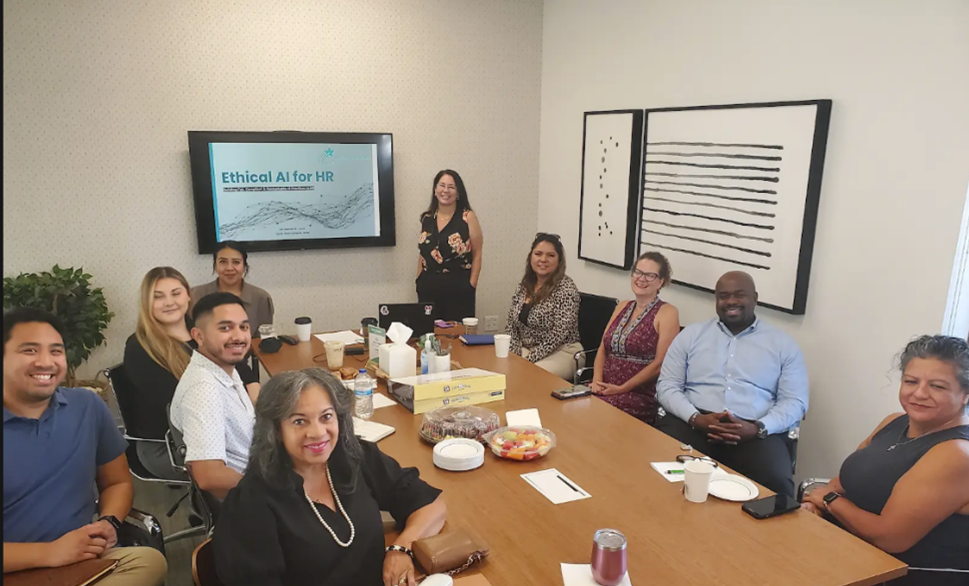
Our March program on Ethical AI for HR brought together professionals across the region to explore how emerging tools are reshaping talent acquisition, employee experience, compliance, and strategic decision‑making. The conversations were rich, practical, and grounded in real world application; exactly the kind of learning environment we aim to cultivate.
Thank you to everyone who attended, asked thoughtful questions, and shared how AI is showing up in your organizations. Your engagement is shaping the direction of our future programming.
What We Heard From You: Member Survey Insights
Your recent survey responses gave us clear guidance on how to better serve you. Here’s what stood out:
Top Geographic Areas of Interest
- Riverside
- Rancho Cucamonga / Ontario
Most Requested Program Times
- 8:00–9:30 AM (before the workday)
- 12:00–1:00 PM (lunch‑and‑learn)
- 5:30–7:00 PM (after work)
We are planning to organize upcoming in-person meetings and programs in these regions to enhance accessibility and promote a community-focused approach to participation. Please continue to check our events page for updates at Inland Empire SHRM Chapter - Upcoming Events.
New Opportunity: Member‑Led Virtual Sessions
One of the strongest themes in your feedback was the desire to learn from each other, the real practitioners doing the work every day.
Member Spotlight Sessions
In response, we are seeking chapter members who can support our HR community by sharing their experiences. If you’ve led a project, launched an initiative, or navigated a challenge that could help another HR professional, we would love to feature you. This is a supportive, conversational format, no formal presentation experience required.
Short virtual sessions where IESHRM members share:
- Programs they’ve implemented
- Lessons learned
- Tools or processes that made a difference
- Culture, talent, or compliance wins
- Innovations that others can adapt
IESHRM is strongest when our members are visible, engaged, and sharing their expertise. Thank you for helping us build a chapter that reflects the needs and strengths of our Inland Empire HR community. We hope that many of you will have an interest in sharing , please email us at [email protected], subject: Member Spotlight Sessions.
I am excited for what’s ahead and grateful to lead alongside you.
Warmly,
Laura Zamora
SHRM Inland Empire Chapter
Welcome New Members

Please join us in welcoming the newest members of SHRM Inland Empire! We’re proud to have you as part of our growing community of HR professionals and leaders. Your experience and perspective strengthen our chapter and support our shared commitment to advancing the people profession in 2026.
Welcome:
- Alexandra Cortez, Walnut Valley Water District
- Desiree Bogan, Cake Mortgage
- Tory Deyo, California Highway Patrol
- Rebekah Castellanos, Housing Authority of the County of San Bernardino
- Aliya Noamani, Core Rehab Solutions Inc.
We’re excited to connect, collaborate, and grow together this year.
Board Members

SHRM Inland Empire is actively seeking talented Human Resource Professionals to support the development of our local HR community. If you are interested in serving on the board of SHRM Inland Empire, please email [email protected]
SHRM Foundation Fundraising Event

Rock & Brews in Corona SHRM Foundation Fundraiser
April 17, 2026 | 12:00 PM - 10:00 PM
Rock & Brews | 3550 Grand Oaks, Corona, CA 92881
Venue website
Join us on the 3rd Friday of every month to eat, drink, and do good! Inland Empire SHRM and Rock & Brews in Corona has partnered to host an ongoing fundraising initiative in support of the SHRM Foundation. Simply inform your server that you are part of the “FUN-draiser” on every 3rd Friday of the month, at Rock & Brews in Corona for dine-in or takeout orders and Rock & Brews will donate 20% of your purchase to the SHRM Foundation. The SHRM Foundation is the 501(c)(3) philanthropic arm of the Society for Human Resource Management. The SHRM Foundation's mission is to mobilize the power of HR and activate the generosity of donors to lead positive social change impacting all things work. The Foundation is committed to elevating and empowering HR as a social force through innovative solutions to workplace inclusion challenges, programming designed to inspire and empower the next generation of HR leaders, and awarding scholarships and professional development grants to educate and develop students and HR professionals.
Why Support the SHRM Foundation?
The SHRM Foundation works tirelessly to address critical challenges facing the workplace, including skills gaps, veteran employment, and promoting diversity, equity, and inclusion. Your participation helps fund initiatives that support HR professionals and drive positive change in workplaces across the globe.
The HR Huddle
April 14, 2026 | 11:00 AM to 12:00 PM | Virtual (Zoom)
Add to Calendar
The HR Huddle series is a valuable resource for HR professionals, offering a monthly deep-dive into the latest legal updates, trends, and best practices in employment law. This collaboration with the legal experts of AALRR equips HR professionals and business leaders with the knowledge to navigate the complexities of the workplace, ensuring they stay ahead in a field that's constantly evolving. In this series, here insights and best practices on topics related to compliance, policy-making, and employee relations, these webinars are designed to strengthen the skills necessary for the dynamic and demanding world of human resources.
The HR Huddle Occurs Every 2nd Tuesday.
There is NO COST TO YOU!
Legal News
With pay data reports for 2025 due May 13, 2026, California-based private employers’ attention is starting to turn to compliance with the annual reporting obligation. Senate Bill 464 (2025) changed the pay data reporting obligations, introducing new requirements effective this year concerning liability and information storage, and in new job categories for 2027. In complying with reporting obligations this year, and preparing for reporting next year, employers should consider the following changes imposed by the bill.
Background
Since 2021, California has required covered employers (employing 100 or more employees, including workers employed through labor contractors) to submit annual pay data reports to the California Civil Rights Department (“CRD”). The pay data report includes employee counts by race, ethnicity, and sex across ten specific job categories, employee earnings by pay bands, and both the mean and median hourly pay rates by race, ethnicity, and sex. Pay data pertaining to labor contractor employees must also be reported on a labor contractor employee report (with information supplied by the labor contractors) if the work performed by the labor contractor employees is within the usual course of business of the employer. A failure to submit such annual pay data reports to the CRD resulted in potential discretionary penalties of $100 per employee and $200 per employee for repeat violations.
Mandatory Imposition of Civil Penalties
Prior law stated that a court “may impose” a civil penalty of $100 per employee for the first infraction and $200 per employee for the second and subsequent infractions related to failures to file such reports. However, SB 464 makes the imposition of penalties in 2026 and beyond mandatory, stating a court “shall impose” a civil penalty for failure to comply.
Demographic Information Storage
Employers must also now ensure that any information for pay reporting purposes is collected and stored separately from employees’ other personnel records. While some employers previously separated such pay reporting data from their employee personnel records, this is now required by law.
Changes to Job Category Classifications
Finally, starting on January 1, 2027, employers’ reporting obligations will no longer be based on EEO-1 categories. Instead, all employees will need to be classified into one of 23 job categories based on the Standard Occupational Classification (“SOC”) system. The following chart compares the EEO-1 versus SOC categories:
| EEO-1 | SOC |
|
1.1 – Executive/Senior Level Officials and Managers |
11-0000 Management |
| 1.2 – First/Mid-Level Officials and Managers |
13-0000 Business and Financial Operations |
|
2 – Professionals |
15-0000 Computer and Mathematical |
|
3 – Technicians |
17-0000 Architecture and Engineering |
|
4 – Sale Workers |
19-0000 Life, Physical, and Social Science |
|
5 – Administrative Support Workers |
21-0000 Community and Social Service |
|
6 – Craft Workers |
23-0000 Legal |
|
7 – Operatives |
25-0000 Educational Instruction and Library |
|
8 – Laborers and Helpers |
27-0000 Arts, Design, Entertainment, Sports, and Media |
| 9 – Service Workers |
29-0000 Healthcare Practitioners and Technical |
|
31-0000 Healthcare Support |
|
|
33-0000 Protective Service |
|
|
35-0000 Food Preparation and Serving Related |
|
|
37-0000 Building and Grounds Cleaning and Maintenance |
|
|
39-0000 Personal Care and Service |
|
|
41-0000 Sales and Related |
|
|
43-0000 Office and Administrative Support |
|
|
45-0000 Farming, Fishing, and Forestry |
|
|
47-0000 Construction and Extraction |
|
|
49-0000 Installation, Maintenance, and Repair |
|
|
51-0000 Production |
|
|
53-0000 Transportation and Material Moving |
|
|
55-0000 Military Specific |
With very little crossover between the EEO-1 and SOC categories, employers will be faced with the time-consuming task of re-categorization of positions once the reporting period in 2026 concludes.
Conclusion
Employers should consider taking the following steps regarding pay reporting obligations due to SB 464:
- Coordinate internally and with labor contractors to ensure data is complete for the upcoming May 13, 2026 reporting deadline;
- Keep the pay reporting data separate from employee personnel files if not already doing so; and
- Begin assigning job titles to one of the twenty-three new SOC job categories in an accurate and strategic manner for the 2027 reporting period.
2026 reports using the new SOC categories will be due May 12, 2027, so employers will have time to readjust the categorization of employee job categories from the 10 EEO-1 categories to the 23 SOC categories.
Employers with questions regarding the pay data reporting obligations may contact the authors or their usual employment law counsel at AALRR.
This AALRR publication is intended for informational purposes only and should not be relied upon in reaching a conclusion in a particular area of law. Applicability of the legal principles discussed may differ substantially in individual situations. Receipt of this or any other AALRR publication does not create an attorney-client relationship. The Firm is not responsible for inadvertent errors that may occur in the publishing process.
© 2026 Atkinson, Andelson, Loya, Ruud & Romo
More Legal News
A federal Court of Appeals recently issued a straightforward but important reminder that courts will treat arbitration agreements as contracts, and contracts require mutual assent and proper execution. Mertens v. Benelux Corp., No. 24‑50954 (5th Cir. Dec. 17, 2025). An employer’s inadvertent failure to countersign an arbitration agreement – no matter how well-intentioned the employee arbitration agreement process – can expose employers to the full range of litigation, including class actions and representative claims, that such agreements were designed to avoid.
Employers across all industries should consider this decision as a prompt to review their arbitration processes and confirm that their agreements are being executed properly and consistently.
Factual and Procedural Background
The plaintiffs in this case were employees of Benelux Corporation, which operated Palazio Men’s Club in Austin, Texas. In 2024, the plaintiffs filed suit against Benelux alleging violations of the Fair Labor Standards Act (“FLSA”).
In 2020, Benelux distributed an arbitration agreement to its employees. The agreement had the following features:
- The signature page of the agreement stated that by signing, both the “Employee and the Club’s Representative” represented that they had read and understood the agreement and agreed to be bound by its terms.
- The page contained two separate signature blocks — one for “Club” and one for “Employee.”
The named Plaintiff, Belen Cadena, signed and dated both signature blocks when she received the agreement. However, Benelux’s General Manager – who routinely countersigned employee arbitration agreements – inadvertently failed to sign Cadena’s agreement. The General Manager testified that, upon seeing the “Club” signature block had been filled in (by Cadena), he mistakenly assumed another representative had signed on behalf of Benelux.
After plaintiffs filed the lawsuit, Benelux moved to compel arbitration. Cadena opposed the motion, asserting that the agreement was unenforceable because Benelux had never signed it. Cadena contended that she did not intend to be bound by the arbitration agreement unless and until Benelux also signed.
The U.S. Magistrate Judge recommended denial of the motion to compel, and the district court adopted that recommendation, concluding that the agreement’s language expressly required both signatures and that no valid arbitration agreement was formed. Benelux appealed.
Reasoning, Holding, and Decision on Appeal by the Fifth Circuit
In applying Texas state law, rather than Federal Arbitration Act precedent, the Fifth Circuit affirmed the district court’s denial of Benelux’s motion to compel arbitration, holding:
- The Employer’s Unsigned Agreement Was Unenforceable
Under Texas law, a valid contract requires offer, acceptance in strict compliance with the terms of the offer, meeting of the minds, each party’s consent, and execution and delivery with mutual intent to be bound. The court focused on the execution element, finding that the agreement’s language – requiring both the employee and Benelux’s representative to sign – unambiguously made mutual signatures a condition precedent to enforceability.
- “By Signing” Language Plus Dual Signature Blocks Controls
The court found that the combination of a “by signing” clause referencing both parties together with dual signature blocks was sufficient to require the employer’s signature. The court drew on analogous Fifth Circuit precedent (Huckaba v. Ref-Chem, L.P., 892 F.3d 686, 688 (5th Cir. 2018)) and Texas appellate authority (CC Rest., L.P. v. Olague, 633 S.W.3d 238, 240–41 (Tex. App.—El Paso 2021, pet. dism’d)), both of which invalidated employer-unsigned arbitration agreements with similar language.
- Conditional Language Is Not Required
Benelux argued the agreement should still be enforceable because it contained no express conditional language (e.g., “shall not be effective unless signed by both parties”). The court rejected this argument, holding that while explicit conditional language is highly indicative of a signature requirement, it is not legally necessary under Texas law. The court held that the plain meaning of language referencing both parties’ execution is sufficient.
- Conduct Cannot Substitute for a Required Signature
Benelux further argued that its conduct – drafting, offering, receiving, and attempting to enforce the agreement – evidenced its intent to be bound and should substitute for the missing signature. The court declined to reach this argument holding that where the agreement’s express language unambiguously requires both signatures, the inquiry ends with the contract’s text, and that extrinsic evidence of conduct was irrelevant.
Although this case was decided under Texas law, it serves as a good reminder to understand and follow through on the employer’s contractual obligations entailed in rolling out arbitration agreements.
Practical Tips for Employers in the Wake of Mertens v. Benelux Corporation
- Review your organization’s arbitration agreement’s language carefully. Agreements that reference only the “Employee” in the signature clause (e.g., “by signing, Employee acknowledges”) present a lower risk of invalidation due to a missing employer signature. However, agreements referencing both parties and that contain dual signature blocks evidence a mutual agreement, which may enhance enforceability.
- Audit existing arbitration agreements. If your organization’s arbitration agreement contains a “by signing” clause referencing both parties and/or includes dual signature blocks, treat the employer’s countersignature as mandatory. If these or similar provisions are present in your company’s agreements, review all existing employee files to confirm that agreements on file bear both signatures.
- Consult counsel about remediation. Retain and consult counsel to evaluate the language in your organization’s arbitration agreements pertaining to the Federal Arbitration Agreement and signature requirements, as well as to advise on strategies to strengthen arbitration agreements in case they are challenged in court.
This AALRR publication is intended for informational purposes only and should not be relied upon in reaching a conclusion in a particular area of law. Applicability of the legal principles discussed may differ substantially in individual situations. Receipt of this or any other AALRR publication does not create an attorney-client relationship. The Firm is not responsible for inadvertent errors that may occur in the publishing process.
© 2026 Atkinson, Andelson, Loya, Ruud & Romo

